We believe that in the era of digital farming, transparency is no longer a luxury — it’s a necessity.
In today’s global marketplace, transparency is the new trust. Consumers want to know exactly where their food comes from — who grew it, how it was cultivated, and whether it’s truly sustainable. To meet this growing demand, the agricultural industry is embracing traceability technologies that track a product’s journey from the farm to the consumer’s plate.
Understanding Traceability in Agriculture
Traceability refers to the ability to track the history, location, and movement of a product throughout its entire lifecycle. In agriculture, this means capturing every step — from cultivation and harvesting to processing, packaging, and delivery.
Several technologies make this possible:
-
Barcodes and Data Matrix codes for basic identification.
-
RFID tags that enable wireless and multi-item tracking.
-
IoT sensors for real-time monitoring of soil, temperature, and humidity.
-
Blockchain technology, which ensures data transparency and tamper-proof records.
-
Digital Twins and synthetic DNA Markers create unique digital or molecular identities for products.
Among these, QR code traceability has emerged as one of the most practical and consumer-friendly innovations.
The Rise of QR Code Traceability
Traceability is a key tool for improving food safety and quality.
- FAO (Food and Agriculture Organization)
QR code-based systems are transforming the Agri-Supply chain by providing instant, verifiable, and user-friendly access to product information. With a simple smartphone scan, consumers can view a product’s origin, certifications, and environmental impact, helping them make informed choices.
For businesses, QR traceability isn’t just a marketing feature — it’s a powerful transparency tool. It helps prevent counterfeit products, simplifies compliance with global regulations, and builds long-term customer trust.
For example, when each product is linked to a unique QR code containing verified information, counterfeiters can no longer fake authenticity. This ensures that every product scanned is genuine and traceable to its original source — a critical step for maintaining brand integrity and consumer confidence.
Why Traceability in Agriculture Faces Challenges in India — And How True Innovation Can Fix It
Transparency in supply chains is becoming a regulatory requirement worldwide.
As consumers become more conscious about the food they eat, traceability has emerged as a game-changing tool for agriculture. It helps track a product’s entire journey — from the farmer’s field to the consumer’s plate — ensuring authenticity, quality, and accountability at every step.
While global markets have rapidly adopted such systems, India’s journey toward transparent agriculture is still evolving. Despite promising pilots and government initiatives, many traceability platforms have struggled to sustain adoption or win market trust.
Challenges in Implementing Traceability Systems in India
1. Limited Digital Literacy Among Farmers
A large number of Indian farmers are still not familiar with digital platforms, QR systems, or mobile apps. This creates dependency on intermediaries for data entry — reducing accuracy and ownership.
Using mobile apps, QR systems, or blockchain portals often requires training and support, which increases project costs and slows adoption.
2. Lack of Digital Infrastructure in Rural Areas
Many farming regions still face poor internet connectivity, low smartphone penetration, and limited access to digital tools.
Without reliable connectivity, uploading real-time data (like QR scans, soil data, or field updates) becomes inconsistent.
3. High Implementation and Maintenance Costs
Setting up traceability platforms requires QR generation systems, IoT devices, blockchain servers, and field validation teams. Due to these high operational costs most initiatives lose momentum after initial deployment.
4. Lack of Standardized Framework
5. Fragmented Supply Chain and Lack of Standardization
India’s Agri-supply chain is highly fragmented, involving multiple middlemen, traders, and transporters.
Each stage adds data gaps, making end-to-end tracking difficult without a common digital standard or centralized database.
6. Weak Data Verification and Authenticity
Many traceability systems depend on manual data entry without ground-truth verification.
If field data is inaccurate or manipulated, the traceability system loses its credibility.
7. Resistance to Transparency
While consumers appreciate openness, some intermediaries prefer opacity to hide quality issues or pricing margins.
Such resistance makes it challenging to build a fully transparent supply chain.
8. Ground Verification Challenges (Ground Truthing)
To ensure traceability data is genuine, ground truthing (physical verification) is essential — but it’s labor-intensive and costly.
Many projects skip this step, leading to unreliable or fake traceability records.
9. Data Privacy and Security Concerns
Farmers worry about how their Personal data will be stored or used. Storing farmer and product data digitally introduces cybersecurity risks.
Without robust encryption or blockchain, such systems are vulnerable to data leaks or manipulation, eroding trust among users8. Data Security and Privacy Concerns.
10. Lack of Consumer Awareness
Most Indian consumers don’t yet scan QR codes to verify product origin.
Without strong awareness campaigns, even genuine traceable products fail to engage buyers, reducing motivation for companies and farmers.
11. Weak Integration Across the Supply Chain
Traceability requires collaboration between farmers, processors, transporters, and retailers.
Many stakeholders still operate in silos, making end-to-end tracking difficult.
12. Limited Policy and Government Push (Earlier Stage)
Until recently, India had no unified national framework mandating traceability for domestic markets.
Most efforts were voluntary or limited to exporting crops like coffee, tea, or spices.
This slowed adoption among Agri-business and cooperatives.
Why Many Companies Failed to Win Market Trust
Traceability supports ethical sourcing and reduces fraud.
- International Organization for Standardization (ISO)
Despite strong ideas, many Agri-Tech companies and startups have struggled to scale or sustain their traceability platforms. Here’s why:
1. Incomplete Implementation
2. Farmer Distrust
3. Over-promising, Under-delivering
4. Poor Consumer Engagement
Many companies launched traceable products but never explained why customers should scan them.
Without emotional connection or awareness, QR codes remained unscanned, and the system lost purpose.
5. Data Manipulation or Inconsistency
6. Short-Term Projects
7. Lack of Local Customization and Complex User Interfaces
8. Data Inconsistency
9. Inconsistent Data and Trust Deficit
Manual data entry, missed updates, and lack of ground verification created inaccurate trace histories. Once data integrity was questioned, trust collapsed — both from buyers and regulators.
Meero Digital Labs: Redefining Agricultural Transparency with meeTAG Traceability
Meero Digital Labs Pvt. Ltd., headquartered in Mumbai, is an Agri-Tech company focused on empowering farmers through integrated, technology-driven agricultural solutions. The company aims to improve farm productivity, increase farmer incomes, and promote sustainable use of natural resources by addressing challenges such as soil degradation, inefficient input use, and groundwater stress.
Meero Labs offers a comprehensive digital ecosystem that includes soil testing labs, moisture sensors for efficient irrigation, AI-based crop and nutrient advisory, hyperlocal weather forecasting, and multispectralimaging for crop health monitoring. Its traceability solution, meeTag, along with secure blockchain-based data systems, ensures transparency, trust, and better decision-making across the agricultural value chain, supporting climate-resilient and farmer-centric agriculture.
Introducing meeTAG – A Transparent Link Between Producer and Consumer (or meeTAG – Transparency From Producer to Consumer)
Digital traceability strengthens market access for farmers.
Going beyond field technology, Meero Labs has stepped into the digital supply chain with a groundbreaking initiative — “meeTAG”, a traceability service designed to connect farmers and consumers like never before.
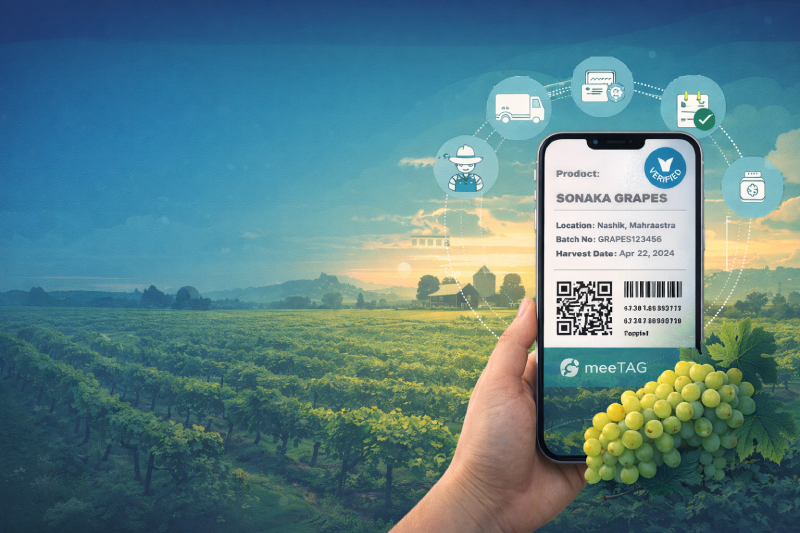
To promote transparency and trust in the Agri-Value chain, Meero Labs has developed meeTAG, a QR code-based traceability service. This innovative platform bridges the gap between producers and consumers by providing complete, verified information about every agricultural product — from its origin to its nutritional value — in a secure and user-friendly manner.
Imagine picking up a mango and, with just a quick scan on your phone, seeing the name of the farmer who grew it, where it was cultivated, what fertilizers were used, and even watching a short video about its journey. That’s the power of meeTAG.
Each product is assigned a unique QR code that carries identical information but a distinct serial number for individual identification. For instance, if a mango farmer produces 10 dozen mangoes, 120 unique QR codes will be issued, one for each fruit. When a customer scans a QR code using a mobile camera or Google Lens, they can instantly view authentic details about the product and its producer.
When a consumer scans any of those codes using their mobile camera or Google Lens, they instantly access authentic details such as:
The farmer’s name, location, and brand.
The company or FPO’s name and logo.
Photos of the product and packaging.
Certificates like GI tags or quality marks.
Geo-location of the farm or factory.
Nutritional value, health benefits, and a short video showing cultivation or packaging.
And even the farmer’s story behind the product.
Key Features of meeTAG Traceability System
Farmer-Friendly Design: The platform is designed in simple, multilingual interfaces, ensuring that even small and marginal farmers can easily use and understand it without technical barriers.
Verified and Ground-Checked Data: Every record in meeTAG is authenticated through ground truthing and digital validation, ensuring that all information shown to consumers is accurate and verified.
Blockchain-Powered Security: All farmer and product data is secured using blockchain, making it tamper-proof and privacy-protected — ensuring trust across the supply chain.
Two-Way Transparency: Unlike traditional one-way systems, meeTAG allows both consumers and farmers to interact with the data. Farmers receive real-time feedback, scan counts, and location insights, while consumers gain full product transparency.
Interactive Scan Analytics: The system displays scan data and geo-locations on an interactive map —green showing the initiation of engagement areas and red highlighting high-scan regions. Farmers can also view this information in a table format, helping them identify market trends and plan their strategies effectively.
Consumer Awareness and Engagement: meeTAG bridges the gap between producers and consumers by offering visually rich product stories, videos, and nutritional details — turning a simple QR scan into a trust-building experience.
Value Creation for Farmers: By giving farmers visibility, recognition, and global reach, meeTAG transforms traceability into a tool of empowerment and profitability — not just compliance.
Vocal for Local Initiative: meeTAG supports Hon’ble Prime Minister Shri Narendra Modi’s call for “Vocal for Local” by promoting local farmers, FPOs, and Agri-Brands through digital traceability. It helps small producers build their brand identity, gain consumer recognition, and access wider domestic and global markets directly from their local roots.
Durable and Safe QR Stickers: meeTAG uses water-resistant, cost-effective QR code stickers available in various sizes, suitable for everything from individual fruits, packets of vegetables, large grain packets and even boxes and wooden crates. The adhesive used for the meeTag is edible and non-toxic, ensuring its safety for direct application on food products.
Two-Way Transparency – A Win-Win for Farmers and Consumers
Unlike traditional traceability systems, meeTAG ensures two-way transparency — benefitting both consumers and producers: meeTAG is not just for customers — it’s equally valuable for farmers.
For Consumers:
They receive complete product information in multiple language options, ensuring accessibility and trust.
For Producers and Farmers:
They receive customer feedback directly through the system.
Track where their products are reaching through geo-location data collected from first-time scans.
The number of scans and their locations are displayed on an interactive map using color codes — for example, green indicates a low number of scans, while red shows high engagement areas.
Farmers can view this information in both table format and map view, helping them analyze market reach, identify regional demand patterns, and plan marketing strategies more effectively.
To maintain data accuracy, Meero Labs limits each QR code’s tracking function — only the first scan records geo-location and count. Subsequent scans show the same product data to customers, but no additional tracking information is collected.
Shaping the Future : Smart, Transparent Farming
The future of agriculture lies in transparency, technology, and trust. Traceability systems like meeTAG are setting a new standard for responsible and sustainable farming by bringing producers and consumers closer than ever before.
By combining AI, IoT, and blockchain, Meero Labs is not just digitizing agriculture — it is humanizing it, ensuring that every product carries a story, every farmer gains recognition, and every consumer makes an informed, confident choice.
With meeTAG, Meero Labs is leading the way toward a future where every harvest is traceable, every farmer is visible, and every product is trustworthy.
Why Traceability Matters More Than Ever
The world is moving towards responsible consumption and sustainable farming. Governments, exporters, and consumers alike are demanding verified origin and transparency in food products.
Traceability isn’t just a buzzword — it’s becoming a compliance requirement, especially for exports, organic certification, and food safety standards.
With solutions like meeTAG, Indian farmers now have the tools to:
Build credibility in global markets and strengthen their connection with consumers worldwide.
Earn premium prices for authentic produce.
Conclusion
In a world where consumers increasingly demand transparency, authenticity, and accountability in the food they consume, traceability has emerged as a critical pillar of modern agriculture. It is no longer just about tracking products—it is about building trust, ensuring quality, and empowering farmers by giving visibility to their hard work. Traceability connects the farm to the fork, enabling informed choices for consumers while opening new market opportunities for producers.
In this evolving landscape, meeTAG by Meero Labs stands out as a farmer-centric traceability solution that transforms transparency into real value. Through simple QR code–based access, secure data management, multilingual interfaces, and two-way transparency, meeTAG allows consumers to know the story behind their food while enabling farmers to track market reach, receive feedback, and build their brand identity. By making traceability practical, affordable, and inclusive, meeTAG ensures that transparency is not a burden but a pathway to sustainable growth, stronger consumer trust, and a more resilient agricultural ecosystem.